Victoriana Bedding Out
“Carpet bedding” as it is also known, soon became an element of many gardens during this era. Garden designers implemented the pattern and close planting of the 18th century parterre. The 19th century bedding displayed the bright colors and the showy blooms of new introductions as their central focus, rather than views from a castle window.
Filling out flower beds could be either a simple or quite a complex pattern, often taking geometric shapes. Individual flowers blurred into colorful forms. Uniform height was an important quality. Just as oriental carpets were admired, so the carpet bedding plans sought to mimic the flat and detailed look of a colorful rug.
Heirloom Tulips for Spring Blooms
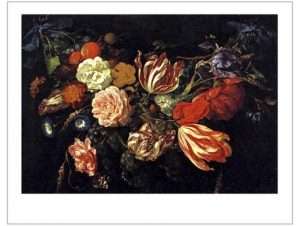
“Festoon with Flowers and Fruits” by Jan Davidsz de Heem circa 1670
Tulip varieties appropriate for heirloom gardens are sometimes difficult to find now.
I remember my grandmother planted ‘Clara Butt’ tulips, and then I did, too. Imagine my disappointment when I looked for some bulbs recently and found they were nowhere to be had! This is the challenge for many of us who wish to populate our “old house” gardens with the types of plants which originally may have been grown there.
Named Tulip Varieties
- ROYAL SOVEREIGN
- ACUMINATA specie
- CLUSIANA specie
- COULEUR CARDINAL
- DUCÂ VANÂ TOLS
- GREUZE
- MURILLO
- GENERAL NEY
- PEACH BLOSSOM
Try double tulips or those with “broken” colors to mimic the look, if you find the actual varieties hard to locate.
Rockeries with spring wildflowers were also popular. Small bulbs, Phlox divaricata, forget me nots, saxifrage, arabis, primroses, and many more.
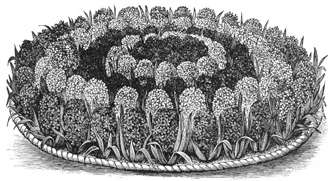
Circle bed planted in Hyacinths
Hyacinth Heirlooms
If bedding out hyacinths in a circle form, a 4 foot diameter bed would require 48 bulbs planted 6″ apart (more if planting closer). Plant outer rows first for uniformity.
- DISTINCTION
- L’INNOCENCE
- CHESTNUT FLOWER
- CITY OF HAARLEM
- GENERAL KOHLER
You may be lucky enough to source these, but if not, choose from those hyacinths offered and plant them like the Victorians did!
Flower Varieties for Carpet Bedding
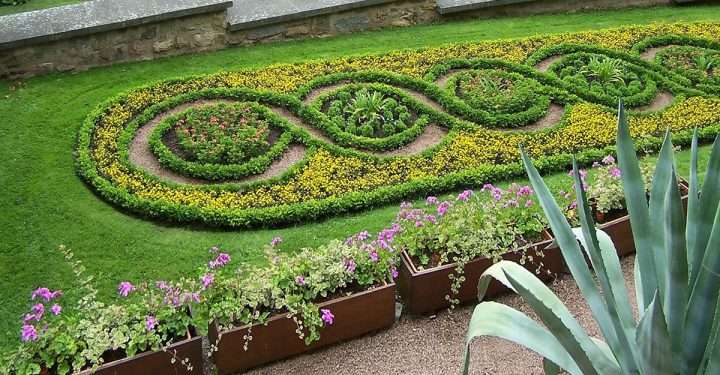
Victorian carpet bedding made designs using uniform flowering plants
When plantings, especially of annuals, were arranged more for color designs than for features of the individual flowers, the style was known as “carpet bedding”. Uniform heights and colors formed lines and blocks will achieve the geometric or mosaic-like beds of blooms,
Victorian Gardner’s Favorite Bedding-out Flowers
| sun | shade | sun/part shade |
|---|---|---|
| ageratum | begonia | convolvulus |
| celosia | coleus | geranium |
| petunia | mimulus | sweet alyssum |
| gladiolus | salvia | |
| portulaca | canna | |
| four o’clock | ||
| gomphrena |
Carpet Bedding
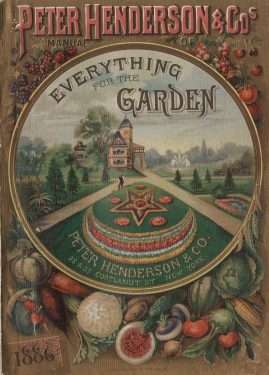
Victorian catalog showing carpet bedding
Favorites for bedding included red salvias, verbenas, celosias, and foliage plants. Massive foliage was favored, like the poisonous Castor plants, or large Cannas. Intricate French Parterre designs made of begonias, coleus, sweet alyssum, and ageratum became all the rage. Consequently, most of the annuals we know as common summer flowers, including petunias were grown by Victorian gardeners; just not in the modern forms and colors.
A Victorian Garden has Mixed Flower Types
Mix of annuals, biennials, and perennials give blooms of different heights, as well as bloom time. The annuals are usually the longest flowering plants.
- daylilies
- hollyhocks
- larkspurs
- nasturtiums
- pansies
- peonies
- poppies
- snapdragons
- sunflowers
- sweet williams
Ageratum, Alonsoa, Amaranthus, Aster
Scarlet Basil, Begonia Tuberous, Begonias
Caladium, Calendula, Campanula, Chrysanthemum, Cockscomb, Coleus
Dianthus, Dusty Miller, Fern, Fuschia
Geranium, Scented Geranium, Heliotrope
Impatiens, Lobelia, Marigold, Moonflower, Morning Glory, Nasturtium
Oxalis, Pansies,, Periwinkle, Petunia, Portulaca, Primrose, Roses, Miniature Roses
Snapdragon, Sweet Alyssum, Thunbergia, Verbena, Zinnia
Specimen Plant Features
The use of plants with strong structure and interesting forms to create a singular feature. They became a favored element of Victorian gardens. The purpose of such plantings was to mark out the single plant and draw attention, The complete opposite of carpet bedding’s loss of plant identity.
While today we might favor a a tree for its beauty ( say, a Japanese Maple), the Victorians would just as well choose something for its curious appearance. For instance, a “Monkey Puzzle” tree or a “Harry Lauder Walking Stick” Corylus Avellana Contorta.
Ideas for Specimen Plantings in Victorian Gardens
- Cornus kousa, the Chinese dogwood
- Weeping Crabapples or Cherry trees
- Castor Bean Plants (be aware that the bean is toxic)
- Shrubs with unusual coloring
- Ginkgo biloba shade tree
As long as it can hold its own when planted as a specimen, any tree, shrub, or large plant can be used. The point is to view the features that makes it either interesting or beautiful. Certainly, if you wish to stay true to the period, be sure it isn’t a new cultivar, but one that was available in the late 19th century.
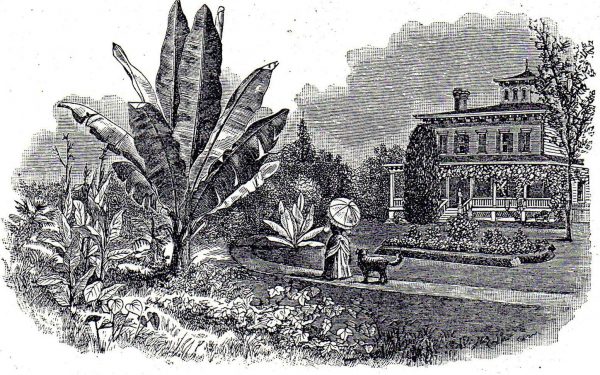
Banana Plant Specimen in a Victorian Estate garden
Other Features Favored by Victorians
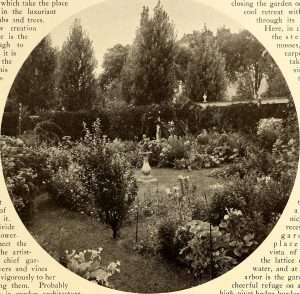
Rose gardens were in their heyday in this period. Roses were bred for more color and repeat blooming, and many more types of roses proliferated at this time. Most of the rose gardens were planted in formal styles with strong hardscaping such as pathways.
Yards were often dotted with planting urns, porches were festooned with vines like honeysuckle or Dutchman’s Pipe.
Notably, special places like fern gardens and grottoes were incorporated into shady parts of the landscape.
Formal features like rhododendron alleés or azalea glens made use of these shrubs that were introduced by plant exploration in East Asia.
Rockeries of many sizes and complexity of plan were beloved by nineteenth century homeowners.
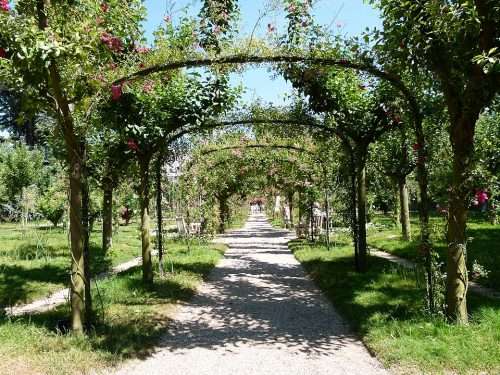
Allee de rosiers
Links to Learn More

Victorian Gardens (Schiffer Book)
Victorian Gardens (Schiffer Book)
| Binding | Hardcover |
|---|---|
| Brand | Schiffer Publishing |
| Edition | 1 |
| Manufacturer | Schiffer |
| Number Of Items | 1 |
| Number Of Pages | 160 |
| Part Number | 200+ color photos |
| Product Group | Book |
| Publication Date | 2004-12-30T00:00:01Z |