Clouds
Types of clouds
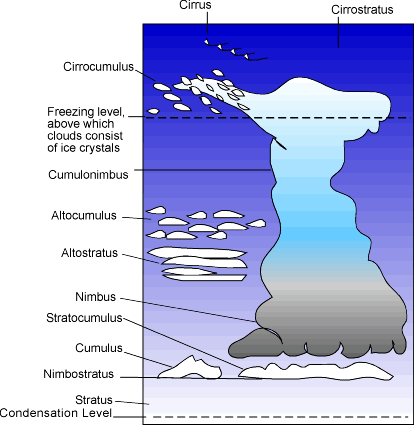
There are ten basic types of clouds categorized by both their appearance and their height above the earth’s surface. The four major cloud groups are high, middle and low clouds, and clouds with extensive vertical development.
Examples of different cloud types | ||
Altostratus | Altocumulus | Cirrostratus |
Cirrocumulu | Cirrus | Cumulonimbus |
Cumulus | Nimbostratus | Nimbus |
Stratocumulus | Stratus | |
High
High clouds generally form above 6000 m. Because the air is cold and dry, high clouds are composed almost exclusively of ice crystals. These clouds also tend to be very thin. Cirrus (Ci)clouds are the most common of this group and can be blown into long, wispy streamers often called mare’s tails. Cirrus clouds have little vertical development. Cirrocumulus (Cc) clouds are an infrequently seen type of high cloud. These clouds can occur individually or in long rows and often have a “rippled” appearance. This rippling looks like fish scales in the sky and the appearance of Cc clouds is sometimes referred to as a mackerel sky. These clouds are composed mainly of ice crystals and have little vertical development. Cirrostratus (Cs) clouds are common high clouds that have a sheetlike appearance. Cs clouds have varying vertical development and are cold and dry. Thick cirrostratus clouds indicate impending bad weather. Halos are usually associated with cirriform clouds.
Middle
Middle clouds have bases between 2000 and 7000 m. These clouds are composed of water droplets and ice crystals (if temperature is low enough). Altocumulus (Ac) clouds are puffy and can be found in varying shades of gray. They are mostly water droplets and have moderate vertical development. Altostratus (As) clouds are a combination of water droplets and ice crystals that are gray to blue gray in color. Altostratus clouds usually block out a majority of sunlight light and result in gray, dreary days.
Low
Low clouds, with their bases lying below 2000 m, are almost always composed of water droplets. The Nimbostratus (Ns) clouds are dark gray and are associated with continuously falling rain or snow. Nimbostratus clouds can occupy the entire sky and have moderate vertical development. Ns clouds are associated with stratus, fractus, and scud clouds. Stratocumulus (Sc) clouds are low, rounded, and “lumpy” with small patches of blue sky in between. These clouds are much larger elements than altocumulus but are not associated with precipitation. Stratus (St) clouds are typically a uniform grayish color covering over the entire sky. These clouds are often mistaken for a fog, but they do not touch the ground. They may be associated with small amounts of precipitation, such as drizzle, but do not produce larger precipitation.
Cumulus
Clouds with large vertical development include the puffy, “floating cotton” appearance of the cumulus (Cu) cloud is a common sight. These clouds can be distinguished from a stratocumulus cloud by the large amounts of sky visible between each cloud, compared to the relatively small space between the Sc clouds. There are three sub-groups of the cumulus cloud group:
1. Cumulus humulis – has little vertical development
2. Cumulus congestus – is a towering cumulus
3. Cumulonimbus (Cb) – has a great deal of vertical development, also known as thunderstorm clouds
Other Miscellaneous Cloud Types
Lenticular clouds – mountain waves, banner clouds
Pileus clouds – these clouds are formed when moist winds are deflected up and over cumulus clouds
Mammatus clouds – produced by moist, sinking air cooler than the surrounding air mass
Contrails – sometimes produced by aircraft
Nacreous clouds – found in the stratosphere
Noctilucent clouds- clouds found in the upper mesosphere.
originally appeared on isu.edu site.