

Ever since that first year at the first house I owned, Cherry trees have found a place in my landscape and in my heart. It doesn’t matter whether they are sweet cherry trees or sour cherries, these trees are beauty, food, and shelter in my garden.
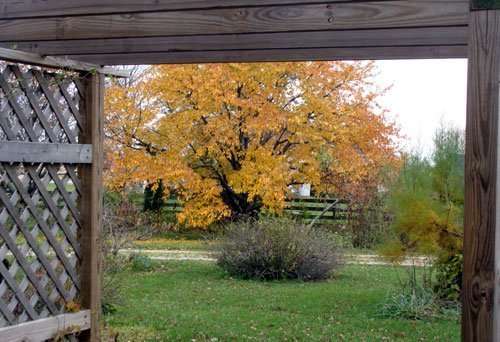
Arbor view of Sweet Cherry tree in the Autumn
To tell you the story:
We had moved into our first house in a rundown neighborhood. At the back of the city lot, right near the alley was an old sweet cherry tree. I located my compost pile underneath, and fertilized the sparse grass underneath the tree that first year. The next spring I received the most wonderful surprise of spectacular white cherry blossoms, and a following harvest of delicious, dark red cherries.
I don’t know if I ever experienced garden joy quite like that at any other time. Maybe because came unexpectedly, unasked and unplanned.
Cherry tree blossoms inspire poetry, and the Japanese have a special festival to celebrate the ephemeral beauty of the cherry. For most of us, we revel briefly in the scent and bloom, but it is the delicious fruits of Prunus avium or Prunus cerasus we look for each June.

This Cherry was one of the first trees I planted on my property.
Prunus Spp. Means Cherry
Actually it means “Plum Tree” in Latin ( think of prunes. However when I see it in the Latin name…. I think of a Cherry tree.
What Types of Cherry Trees Produce Fruit?
I have grown two types of cherry fruits in my gardens, ever since that first introduction to that first magnificent cherry tree. I want to present them here as examples of my favorite trees for the garden.
Despite both being of the Prunus genus and grown for their fruits, these two types of fruit trees are very different.
The Sour Cherry
Of the two, the Prunus cerasus is the most useful for cooking. Its fruits make the best pies, are used to flavor all sorts of dishes from meat entrees to salads (when dried) to desserts.
As a tree in the landscape it is much smaller, and for me, shorter lived than its cousin the Sweet Cherry.
Here are the Sour Cherry Tree Facts:
- Height: possibly to about 19′, but often smaller to about 15′
- Width: broad crowned to about 19′
- Soil: Average fertile soils, tolerates most conditions but should be well drained
- Sun: Full sun to part shade
- Moisture: Medium moisture
- Zone: Hardy in zone 4-7
These trees will grow in maritime areas and can take some wind and salt. They are self-fertile and Montmorency is one of the most popular varieties. I’ve it and the North Star variety. I like the fruits of the North Star better, which is supposed to be hardier, both varieties are hardy for me. The Montmorency is a taller tree and grows healthier in my soil, which isn’t ideal for cherries. I lost one North Star, after it thrived for about 15 years.
Both tree varieties will bear heavily, but not every year. Cherries can be ruined by pests such as Japanese beetles, so be aware of this if your area is prone to these insect infestations. Japanese beetles will ruin the fruit and even kill the tree by defoliating over several years.

Very dwarf varieties of Cherry trees are available, so they can be grow as ornamental trees and in small gardens.
 Buy tree now
The Sweet Cherry
Prunus avium usually need for two tree to pollinate each other, although there are self-pollinating varieties available. The “Stella” variety is self pollinating. My own experience: I planted the “Stella” sweet cherry tree , and it does bear dark sweet cherries, but not as heavily as the others.
Sweet Cherry Tree Facts:
- Good drainage
- Soil: Gravelly to sandy loam soils, clay soils reduce production.
- Sun:They need full sunlight and pruning to maintain air and light within the tree
- Zone: 5-7 They need certain amount of chilling weather – no farther South than zone 7
- Moisture: Regular moisture.
- Height: 15-30 ft. with equal spread.
Good cultural practices such as deep watering, mulch that doesn’t touch the trunk, and pruning for good air circulation.
Companion tips for both trees:
DO plant with
Nodules on white clover roots convert nitrogen from the air into nitrates.
Sweet Alyssum attracts beneficial hoverflies.
Borage is irresistible to bees.
Avoid planting with
- black walnut trees
- fennel
- invasive mints
Black Walnut trees compete for shade, and they create unfavorable environment for growing other plants near the roots. Those roots release a toxin, juglone. Likewise fennel is unfavorable for growth. And unruly mints take up too much of the available food and water.


