
Add Jewel-Like Color

Larkspurs are old fashioned flowers that look like delphiniums, only smaller. They come in dark blue to white shades.
Annuals:
Garden Adornment
What is your summer garden without annuals? Like a princess without her tiara and jewels, it is just not dressed for the part.
The non-stop blooms of annual flowers punctuate the border and rim the walk, they dangle from the porch pots and collar the shrubs. Cheerfully and gracefully they ornament plantings in a way perennials would be hard-put to duplicate.
So, what shall we choose? Look over the plant lists and then shop your garden stores and seed catalogs ( make plans to collect and save seeds for many annuals that are not listed as 'hybrids' -which won't come true to form).
Zinnias, bright and easy
Many people start their own flats, which is very worthwhile in more ways than one. I, myself, never bother growing my own petunias, Ageratums, Lobelias, or Marigolds (Tagetes) that way. The flats available from the stores more than meet my needs, and I always grow my marigolds from seed " in situ " with better results. If you need large amounts of other types, or unusual varieties, then starting your own from seed is worth the experimentation. More of my opinion on the matter of economics involved.
If you are a newbie at this- the one important thing to pay attention to is: hardening off. That is the term for gradually introducing your little hothouse plants to the harsher elements of the real outdoors...gradually is the key word.
Annuals Defined
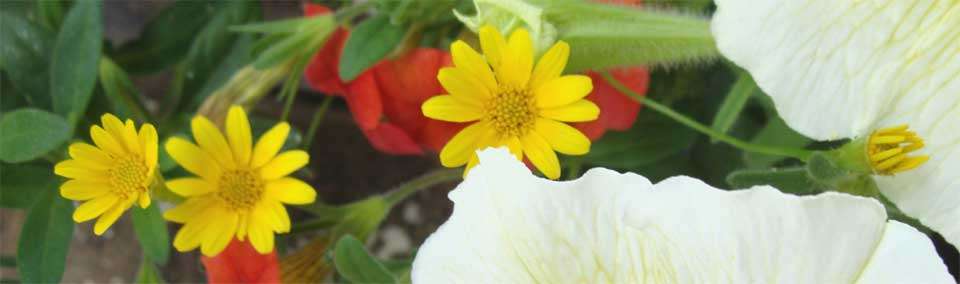
Why is a plant called an annual?It's the life cycle description, an annual is a plant that grows, flowers, sets seed, and dies in the same season. What does this mean to you? That you must reseed the plant every year, and that the plant blooms longer in the garden when the seed setting is delayed (by dead-heading, etc)
Timing
My clay ground is most unforgiving when worked wet, so it seems inevitable, with all the scrambling around in the spring planting, that I don't get to plant all the seeds I wanted. Even so, certain annuals are still worth effort well into June. Zinnias, marigolds, quick starters like Candytuft and Nigella, portulaca, even half-wilted Petunias will revive (if you lop their heads off and give their roots soft earth and moisture). Many of the mixed annual packets have quick starting plants that can be sown at a late date.
I would say the last week of June is the cut-off point, though.

Growing annuals in containers is one of the most adaptable ways to brighten up the garden. One of the plantings I'm repeating this year is a success of the past: two raised beds planted with small bulbs followed by tiny delicate annual flowers. Hanging baskets are favorites for porches, and they can be single profusions of just one type of flower or a combination of several chosen companions. Traditional containers such as window boxes have often decorated apartment windows and cottage windows alike. All planted with easy care annuals.
Quicklist: hints and tips
Uses for Annuals

- Filling in spaces in the border
- Any place needing full season color
- Bordering shrubs
- Filling in between new plantings
- Containers of all types
- Accentuating entries
How To Plant Annuals Successfully
Prepare your flower beds:
Add organic matter (which could be peat moss, compost, or well-rotted manure), preferably the season before you desire to plant.
If you have established garden areas, add organic matter several weeks spring planting. Incorporate the additions with a spade or till into the top six - eight inches of soil.
Attention to soil preparation promotes faster and better seed germination -well worth the time taken.
Soil all ready? Good! Now how do you plant those flats of annuals you bought?
Seed Planting Tips
- To start annuals in situ (seeding directly in the soil), level the bed and rake it after tilling.
- Remove stones and clumps of hard earth, so that you have fine tilth and smooth soil surface.
- If planting a bulb bed or under shrubs, dig lightly and shallowly.
- Add a little soil amendment, but don't damage the roots of plants already there.
- Growing in containers means new potting soil each year, since the intensive growth wears out the fertility of the small amount of soil. I use the soil you buy in bags at the plant store, preferably with "moisture control".
- Be sure your containers are big enough. More about container planting, and photos.
Most of the annuals I mention are sown directly into the garden.
It pays in success to prepare the ground with these activities:
- cultivating
- raking
- adding amendments
- keeping consistent moisture during the germinating and early growth stages.
Once plants are given a good start, they are surprisingly adaptive.
One of the annuals I planted "in situ" one season many years ago has been a recurring joy each year: Shirley poppies in the "Fairy Wings" selection.
Every year I have beautiful, crepe paper poppies delicately nodding in the early summer breezes.
They have the most charming colors of lavender gray, pink with white,whites powdered with other pastel shades, and the occasional scarlet brushed with a powdery sheen.
(I found a source for this same named selection: Poppy Fairy Wings 50 Seeds )
Annual Or Perennial? Or Biennial?
Yes, it can be very confusing. When you live in a cold climate many of the plants called, and sold as, annuals are actually tender perennials: begonias, geraniums, heliotrope, etc.
Shirley poppies are an easy annual.
To truly be an annuals a plant must live its life cycle in one season, but tender plants which are frost-killed behave that way. So they are sold as annuals and information on them group these plants as annuals in their lists, etc. It is impractical to make the difference.
And biennials? Those take two seasons to complete, as their label implies, but they are often sold as perennials. A foxglove (Digitalis) is a good example of that. Or Sweet Williams (Dianthus barbatus).
I know, it is confusing, but for garden purposes we play fast and loose with the botanical designations. Most gardeners just want to know how long the plant lasts in the garden, and thus we get "short-lived perennials" and tender perennials grown as annuals.
The list of plants I've grown in my annuals list would be longer if all those tender annuals were included.
Now that you have been introduced to the beauties of annuals, let me further your acquaintance with tips and techniques.
We primarily grow these flowers from either seed or transplants. Whole books are written about seed propagation, but for most of the common garden annuals it is as simple as putting seed in the ground and firming it.
If you buy transplants, my recommended method of planting merited a "how-to" page.
How To Plant Flats Of AnnualsMore on the subject...
Index of Annuals | Containers | Plant Shirley Poppies | A Cutting Garden | Easy Plants To Grow From Seed
A selection of books:
More of the Season:

Annuals I've Grown
Not a complete list
Ageratum houstonianum - Flossflower
Antirrhinum majus - Snapdragon
Annual Bidens
Browallia speciosa
Calendula officinalis
Celosia - Cockscomb
Clarkia amoena - Satin Flower
Cleome hasslerana - Spider Flower
Coreopsis tinctoria - Calliopsis
Cosmos bipinnatus - Mexican Aster
Cosmos sulphureus - Sulphur Cosmos
Dianthus chinensis - China Pinks
Eschscholzia californica - California Poppy
Gomphrena globosa - Globe Amaranth
Gypsophila elegans - Annual Baby's Breath
Helianthus annuus - Common Sunflower
Helichrysum bracteatum - Strawflower
Impatiens - New Guinea Impatiens
Impatiens balsamina - Garden Balsam
Impatiens wallerana - Impatiens
Ipomoea -Morning Glory
Lantana camara - Lantana
Laurentia axillaris 'Blue Stars' - Isotoma
Lobelia erinus - Edging Lobelia
Lobularia maritima - Sweet Alyssum
Mirabilis jalapa - Four-O'Clocks
Nicotiana alata - Flowering Tobacco
Nigella damascena - Love-in-a-Mist
Petunias
Portulaca grandiflora - Moss Rose
Rudbeckia hirta
Salvia coccinea - Scarlet Sage
Sanvitalia procumbens - Creeping Zinnia
Tagetes erecta - African Marigold
Tagetes patula - Dwarf French Marigold
Tagetes tenuifolia - Signet Marigold
Tithonia rotundifolia - Mexican Sunflower
Torenia fournieri - Wishbone Flower
Tropaeolum majus - Nasturtium
Verbena- Garden Verbena
Zinnia angustifolia - Narrowleaf Zinnia
Zinnia elegans - Zinnia
Annuals For Butterflies And Birds:
Plant these for wildlife:
A SHORT LIST:
- Plant these:
- Bachelor buttons
- Calendula
- Candytuft
- Consolida ambigua (Larkspur)
- Cosmos
- Dill
- Garden Balsam,Impatiens balsamina
- Malva alcea (Hollyhock)
- Nasturtium
- Petunias
- Zinnias
Don't Forget
I have two more pages on annuals: color schemes and design ideas and a list of my favorites with descriptions.
Was my garden information worth $2.00 (less than the cost of a latte) to you? If so, please consider a donation:
It would be very appreciated.