Willow trees grow fast, but that is not the main reason to grow them. The main reason is their graceful presence in the landscape.

Weeping Willows are graceful trees
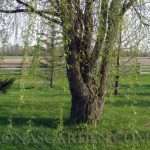
I planted my first willow trees five years ago, and that one is now among the largest trees on the property. It creates a sense of mystery in my too-open yard and filters the view of the road. I have trimmed out some branches and trimmed up some of the drooping fronds to make mowing underneath simpler. It gives the tree a tidier appearance. Plus, I used the extra trimmings to secure make a hazel garden tuteur.
There are many types of willows- it is a big family of garden trees and shrubs, but I am describing the Weeping Willow, Salix babylonica.
How This Tree Looks
- May grow from 30-40 feet tall and 35′ wide.
- Soft green color with distinctive golden green when first leafing out in springtime.
- Light, pendulous branchlets hang down to softly brush the ground
- Gray brown deeply fissured bark
The individual leaves are 3-6″ long and lance-shaped. The fall color is yellow.
How Salix Babylonica Grows
Willow trees are brittle because they grow so rapidly. Native to Asia.
- Zones 5-8
- grows up to 10 ft. a year
- adaptable to many conditions
- little tree litter
- keep away from drains
This tree may grow ten feet a year, and its spread is quite wide. The wood is somewhat brittle and prone to breakage in wind storms or ice storms. For this reason, plus the possibility of drain invasion, it shouldn’t be planted too near buildings.
Out in the yard it is graceful and beautiful.
Weeping Willow Tree Needs
Very easy to grow, the Willow adapts to most soils and conditions.
Loves moisture.
It is a large consumer of moisture, and that is why it inhabits stream banks and other moist areas. Willows actually like standing water, and any lake, pond, or river side makes them happy.
If you don’t have a readily available source of moisture the roots may roam to your house drains. That is not a good thing! Take note if you are thinking about planting a tree in proximity to a house- another tree is probably a better choice, especially since willows are weak wooded trees and branches may break in wind conditions.
Update: My willow has grown quite tall- it has been an imposing presence in my front yard. I still love it. However, I have seen its weaker side. This year (2011), after the most devastating ice storm can ever remember, many of the topmost branches broke under the weight of the ice. I was very glad I planted my willow far from the house. This spring we will prune away the broken parts, and I am sure the tree will regain its beauty- because willows do grow fast.
“The roots are remarkable for their toughness, size, and tenacity of life, and roots readily grow from aerial parts of the plant. –so says the wikipedia“
Fertilize little, if at all.
Sometimes a willow trees gets pests and diseases, including borers and bacterial blight. Subject to problems such as black canker, fungi, cankers, willow scab, crown gall, willow blight, rust, and root rot.

Claude Monet
Weeping willow trees can be pollarded, but it isn’t recommended for those who like the grace of the natural form of this tree.
They may be pruned to fit their situation with less destruction of their form. but if a tree is very old and misshapen, and in need of rejuvenating, you might read this page on how to use the pollard technique.
Propagation to Make More Trees
Simple as pie: just stick twig sprigs into the ground, soft ground that you keep moist.
OR
Cut some branches in spring, strip bottom leaves off and put stems in a jar of water. Allow jar some sun. Roots should grow within 15 to 20 days.
- Willow trees are good for damp areas of the garden
- It is a very fast growing tree
- A beautiful specimen tree
Another of my other pages with notes on Salix babylonica:
Trees I Grow
Fun Facts
Willow branches are used for many types of crafts including making garden ornaments, furniture, and weaving baskets.
They have medicinal and tanning properties.
Sketching charcoal is often made from processed willow bark and trees.
The original aspirin, salicylic acid, was made from willow bark. Today’s aspirin is a synthetic that is easier on the stomach, etc.
The best known of weeping trees, it has been a memorable icon of fond thoughts of loved ones used in art and on gravestones. A famous example of its depiction was captured in Monet’s Water-Lily Pond and Weeping Willow painting.
Keeping a vigil unasleep, | Counting the slow hours upon her leaves, | Marking the passage of the stars beyond, | Till moonshine glimmers pale upon | Her heavy-laden branches | And, bending, sweeps | The tangled, fallen, leaves | Into the fount of all her tears, hopes and fears.
But why? Pray, why? | Hush now, time to sleep. | I’ll tell you–by and by– | Why the sad willow weeps.
~J.C. Hall
The Willow Song; “Desdemona’s song from Othello. The earliest copy is in a lute book dated 1583”
Why some people won’t advise planting a willow tree:
- They seek water greedily, and could invade drains to get the moisture they want.
- Weak wooded trees, they break more easily than stronger trees. May lose large branches in a windstorm or from an ice storm.
- Their weeping branches may be a nuisance over a drive way, or for those on riding mowers.
The choice of whether you have the room, right situation, or desire for these trees will be up to you.
The Magnolia page might also interest you.