Bird’s Nest Spruce
Many dwarf evergreens begin as mutations of some larger tree, and that is true of this popular foundation plant.
‘Nidiformis’, the Nest Spruce, formed from a Norway Spruce witches’ broom. Harvested from an aberration “witches broom“, which superstitious souls once thought came from “bewitched” trees. Now we know scientifically the sources which cause these mutations. Numerous causes create them, most commonly in conifers.
However they come about, the “Bird’s Nest Spruce” once started as the tall growing Norway spruce, of which I have a number on my property- they grow very well in the conditions here.

bonsai birds nest spruce

Mature form picea nidiformis

young shrub form
Good Reasons for Birds Nest Spruce in the Landscape
- Grows slowly
- Requires little maintenance
- Tolerant of many conditions
- Shallow root system
- Useful for foundation planting
- Widely available and inexpensive
How Picea Abies Nidiformis Looks
The color ranges from a dull medium to a dark green with bright spring green tips for new growth.
When young they have a dish like depression in the middle, and don’t grow quickly at first; over time they mound a bit.
The plants can suffer damage in the center from breakage due to snow weight or from attack by spider mites. Preventative care consists of brushing off the heavy snow with a broom in winter, or spraying the plants down with water in summer to discourage spider mites.

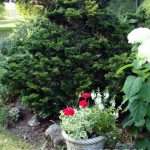
tucked in between some taxus
How to Grow a Bird’s Nest Spruce
- Full sun– everybody says so, but I will let you in on my little secret: I grow it in half sun. I have three areas where I have planted the Picea abies ‘Nidiformis’, a north facing foundation planting, under a crabapple tree, and tucked in between some Taxus bushes. This shrub is doing well in all places, although it is growing very slowly under the crabapple tree.
- Average moisture, although it likes regular watering and an occasional showering off in the hot summertime.
- Hardiness Zones: 3 to 6
- Form: Densely branched, rounded with a horizontal to flat-topped visual impression, spreading shrub; depression in center
- Height 3 Feet X Spread 7-8 Feet

birds nest spruce
Growing Notes
We often group different evergreen shrubs together. A general rule is to allow plenty of space for each mature plant. This dwarf evergreen grows slower than most of the Taxus shrub varieties, so pay attention to “spread” measurements in order to prevent overcrowding.
[Fun Facts]
Learn a little Latin: Picea comes from the Latin word pix, meaning pitch, and Abies is the Latin name for fir. Nidiformis means nest-shaped.
A “Witch’s Broom” is an abnormal, twiggy and unusually dense growth in an otherwise normal tree arising from overstimulated growing points. Plantsmen search for these unusual shapes and growth patterns, in the hopes of finding a useful sport with new qualities.
Good to know:
The Conifer Society has created a growth rate chart.
- Miniature: less than 1 ft. growth annually or less than 1ft. in 10 years
- Dwarf: 2 ft – 6 ft. growth annually or 3 ft -6 ft. in 10 years
- Intermediate: 6 ft -2 ft. growth annually or 6 ft.-15 ft. in 10 years
- Large: more than 12 ft. annually or more than 15 ft. in 10 years
Other varieties:
Blue Birds Nest Spruce (Picea m. ‘Nana’)
Picea abies ‘Little Gem’ came from a “witches broom of a witches broom” to create a very small, slow growing, fairy garden plant.
Another dwarf evergreen that might interest you: Hinoki cypress

More Links: